Social Sustainability is very complex and abstract concept to think about. I can best describe it has the sustainability of the social system of a group or nation. The most obvious movement to push people into a more sustainable social mindset is that of the environmentalist movements. But there have been pushing for the idea of social sustainability such as the civil rights movement, feminism, abolitionist movement, and prohibition movements. These movements seek to change society to suit a more sustainable approach such as reducing crime by reducing poverty and improving equality in civil rights movement. The definition for social sustainability that should be focus on also is the sustainability of our society. Does how we interact with each other, eat, play, and work sustain society indefinitely? If not, what are the reasons and how do we improve those conditions? These are some of the questions that we should be asking ourselves.
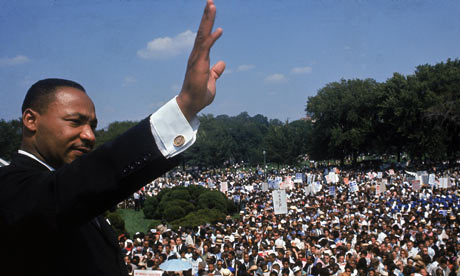 |
| King's American Dream was that racism and prejudice become a thing of the past. |
America in particular has been obsessed with the notion that bigger is better. The American dream has been warped from achieving a place where people have peace of mind into the idea that more money means more happiness. This has been in part because of the perception that the more money society makes means the more develop that society becomes (see earlier blogs). The American Dream has been equated with having more rooms in houses, bigger garages to fit bigger cars, owning personal jets, and an increasingly more inefficient shopping list. Suburbia is just one of the many results of an unsustainable social evolution of America. Why improve the living conditions in the city, when instead you can live outside the city in a bigger house and a big yard? Because of this idea, Suburbia was design for cars and not pedestrians, everyone has to drive everywhere, not to mention the water and chemicals used to maintain their lawns.
 |
The American dream has also become defunct has it promotes societal practice of improvement at the detriment of another. Every time someone puts forward concepts to improve the declining middle class majority in America, it is criticized as class warfare. Taking money from the rich and distributing it to the lower classes which is claimed to destroy the American Dream. The current social view of the economy is that a large pie, with each person having a portion of that pie. The current economic system is a game of how big a share of the money can you suck out of the economy. Because the societal goal is to increase the pie every year, the individual goal is to increase the share of that national pie. This means every year someone loses a portion of their pie to satisfy someone else’s American Dream of bigger is better. This practice has push the middle class closer and closer to poverty and more dependent on dirty cheap fuel and cheap pollutant products. You can see the unsustainable practices accelerating in Washington with ideas such as rejection of tax increases on the rich but the cutting of governmental services that mostly benefits middle and lower classes. Or more directly in industry where Walmart has been criticize by forcing and encourage their underpaid employees to go on government welfare to improve their bottom line instead of using some of their billions of dollars in profits to provide a cheaper health plan.
 |
| Walmart's actual logo equates money to happiness |
Today an increasingly amount of people are disbelieving the American Dream. It is not surprising that people are being battered by the economy and are losing that piece of mind that they had for so long. If we shifted to a society that values achieving that piece of mind instead of the mantra bigger is better, then better consumption practices will follow, and the environmental aspects will become important. The American dream hasn’t become out of reach, we have instead forgotten what the American Dream is.